
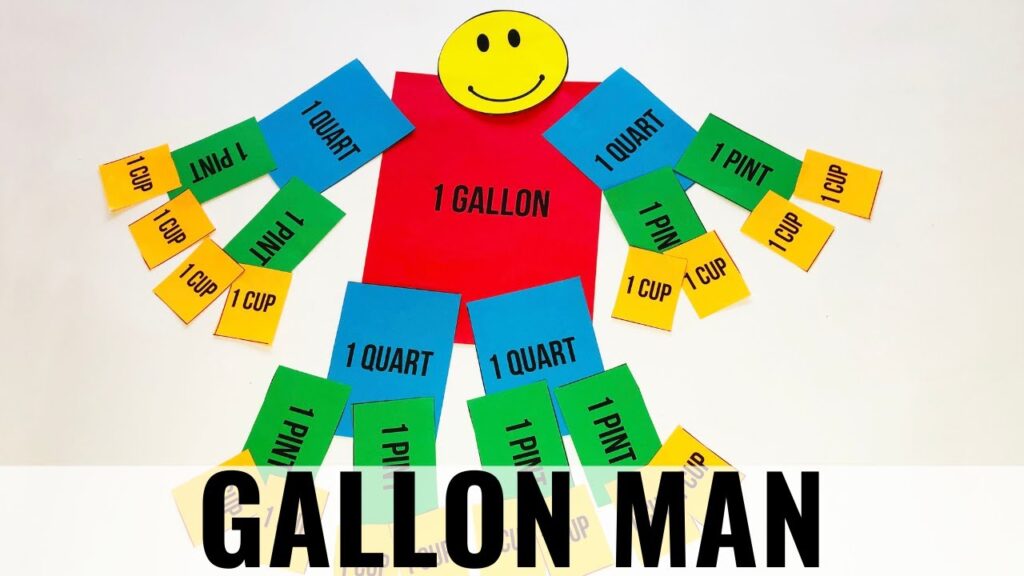
Learning measurements is one of the first real challenges students face when mathematics begins to connect with everyday life. Children are suddenly expected to understand how different units relate to each other, how to convert between them, and how to apply these ideas to cooking, science experiments, and real-world problem solving. For many learners, especially in the early grades, these relationships can feel confusing because they are often taught through memorization instead of understanding.
This is where Gallon Man becomes a powerful teaching tool. Gallon Man is not just a drawing or classroom decoration. It is a visual strategy that transforms abstract measurement relationships into something concrete and memorable. By representing gallons, quarts, pints, and cups as parts of a single character, Gallon Man allows students to see how units fit together rather than trying to remember disconnected facts.
The concept has been used in classrooms for decades because it blends visual learning, storytelling, and mathematical structure. It turns a topic that many students struggle with into one that feels intuitive and even enjoyable. Understanding Gallon Man is not only helpful for children but also for parents, tutors, and educators who want to teach measurement in a way that actually sticks.
Understanding the Concept Behind Gallon Man
At its core, Gallon Man is a visual model designed to explain liquid capacity within the customary measurement system. Instead of presenting conversions as numbers to memorize, the model organizes them spatially. Students learn that a gallon is not just a number but a container made up of smaller, equal parts.
The character is typically drawn as a large outline shaped like a person. Inside that outline are smaller shapes that represent quarts, pints, and cups. Each smaller unit fits perfectly inside the larger one, visually reinforcing the idea that measurements are built from repeating patterns.
This approach mirrors how humans naturally understand size relationships. People grasp ideas more quickly when they can see how pieces connect. Gallon Man uses this principle to transform mathematical relationships into something almost physical, as if the student could take the character apart and rebuild it.
Because of this, Gallon Man is especially effective for visual learners who benefit from diagrams, color coding, and spatial organization rather than rote memorization.
Why Measurement Conversions Are Difficult for Many Students
Before exploring why Gallon Man works so well, it helps to understand why measurement conversions are often hard to learn. Traditional instruction frequently asks students to memorize facts without context. They may be told how many cups are in a quart or how many quarts are in a gallon, but they are not shown why these relationships exist.
Without a mental model, the information feels arbitrary. Students may remember the numbers for a test but quickly forget them because the knowledge is not anchored to understanding. This leads to confusion when they must apply the information in new situations such as solving word problems or working in science labs.
Another challenge is that customary units do not follow the simple base ten pattern found in the metric system. Since the relationships are not evenly scaled, learners need a structure that helps them visualize how the units connect. Gallon Man provides exactly that structure.
How Gallon Man Demonstrates Measurement Relationships
Gallon Man shows that measurement units are nested within one another like building blocks. The large outline represents the gallon as a whole. Inside it are four equal sections representing quarts. Each quart is further divided into two parts representing pints. Each pint is divided again into cups.
This repeated pattern creates a clear visual hierarchy. Students can follow the structure step by step, observing how each level doubles as they move downward into smaller units. Instead of remembering isolated numbers, they remember the pattern of division and grouping.
This nested design helps students understand conversions in both directions. When moving from a large unit to a smaller one, they see how the space expands into more pieces. When converting upward, they can imagine combining smaller parts back into a larger container.
The result is a deeper conceptual understanding rather than surface-level recall.
The Psychology Behind Why Gallon Man Works
Gallon Man succeeds because it aligns with how the brain processes and stores information. Educational psychology shows that learners retain knowledge more effectively when new ideas are connected to visual frameworks. This is known as dual coding, where the brain processes both words and images together.
When students draw, label, or interact with Gallon Man, they activate multiple learning pathways. They are not only hearing explanations but also seeing structure and often physically creating the model themselves. This multi-sensory engagement strengthens memory.
The character format also adds an element of storytelling. Giving the diagram a name and personality makes it feel less like a formula and more like a concept students can relate to. This emotional engagement may seem small, but it significantly increases recall and confidence.
Gallon Man in the Classroom Environment
Teachers often introduce Gallon Man through interactive lessons rather than lectures. Students may construct their own version using paper cutouts, colors, or foldable templates. This hands-on process transforms learning into an activity rather than a passive experience.
As students assemble the model, they see how each unit fits within the next. The act of building reinforces the relationships far more effectively than copying notes from a board. Many educators report that students continue to visualize Gallon Man mentally long after the lesson ends.
The model also supports differentiated instruction. Learners who struggle with abstract reasoning gain a concrete reference point, while advanced students can use the model to explore more complex problems involving conversions and applications.
Supporting Different Types of Learners
One of the strengths of Gallon Man is its flexibility across learning styles. Visual learners benefit from the spatial layout, kinesthetic learners engage through construction and manipulation, and auditory learners absorb explanations tied to the diagram.
Because the model is simple yet structured, it does not overwhelm students with excessive detail. Instead, it presents a clear pattern that can be revisited whenever needed. This accessibility helps build confidence, particularly for students who may feel anxious about mathematics.
Parents and tutors also find Gallon Man useful because it provides a shared reference point. Rather than re-explaining conversions repeatedly, they can refer back to the visual model to guide understanding.
Real-World Applications of the Skills Learned Through Gallon Man
Understanding measurement is not just an academic requirement. It plays a role in everyday activities such as cooking, construction, gardening, and science experiments. When students grasp how units relate to each other, they can estimate, measure, and adjust quantities with confidence.
Gallon Man builds this practical understanding by showing that measurements are flexible and interconnected. Students begin to see how doubling a recipe or measuring liquids in different containers requires the same foundational relationships they practiced visually.
This connection between classroom learning and real-life application helps students recognize the value of what they are studying.
Gallon Man Compared to Traditional Memorization Methods
Traditional methods often rely on drills or charts that present conversions as isolated facts. While these tools may provide short-term success, they rarely lead to lasting comprehension.
Gallon Man shifts the focus from memorization to visualization. Instead of asking students to remember numbers, it encourages them to understand structure. This reduces cognitive load because learners no longer have to recall multiple unrelated facts.
Research in mathematics education consistently shows that conceptual models lead to stronger problem-solving abilities than memorization alone. Gallon Man embodies this principle by making relationships visible and logical.
Modern Adaptations of Gallon Man in Digital Learning
In today’s technology-driven classrooms, Gallon Man has evolved beyond paper diagrams. Interactive whiteboards, educational apps, and digital worksheets allow students to manipulate the model virtually.
These digital versions often include animations that show units expanding and combining, reinforcing the same visual logic in a dynamic format. Online learning environments have adopted the strategy because it translates well to remote education, where visual clarity is essential.
Despite these technological updates, the core idea remains unchanged. Whether drawn by hand or displayed on a screen, Gallon Man continues to serve as a bridge between abstract math and visual understanding.
How Parents Can Use Gallon Man at Home
Parents who want to reinforce measurement skills can easily recreate Gallon Man using simple materials like paper, markers, and scissors. The process of drawing and labeling the figure together becomes an engaging learning experience rather than homework.
Discussing how the parts fit together encourages children to explain their reasoning aloud, which strengthens comprehension. Revisiting the model during cooking or other activities helps connect mathematical ideas to daily routines.
This kind of reinforcement transforms learning into something natural and ongoing rather than confined to schoolwork.
The Lasting Educational Value of Gallon Man
Gallon Man may appear simple, but its impact on learning is significant. It demonstrates how effective teaching tools do not need to be complex to produce meaningful results. By organizing information visually, it allows students to internalize relationships that might otherwise feel confusing.
The model also introduces an important lesson about mathematics itself. Math is not just about memorizing facts but about recognizing patterns and connections. Gallon Man helps students see that structure clearly.
Many learners remember the image years later, long after they have forgotten other classroom details. That lasting memory is evidence of how strongly visual learning can shape understanding.
Conclusion
Gallon Man is far more than a clever classroom illustration. It is a thoughtfully designed educational strategy that turns measurement conversions into something logical, visual, and memorable. By showing how gallons, quarts, pints, and cups relate to each other within a single framework, it replaces rote memorization with meaningful comprehension.
In an era where educators seek methods that engage diverse learners and promote deep understanding, Gallon Man remains a timeless example of effective teaching. It proves that when students can see how ideas connect, they are far more likely to understand, retain, and apply what they learn.