
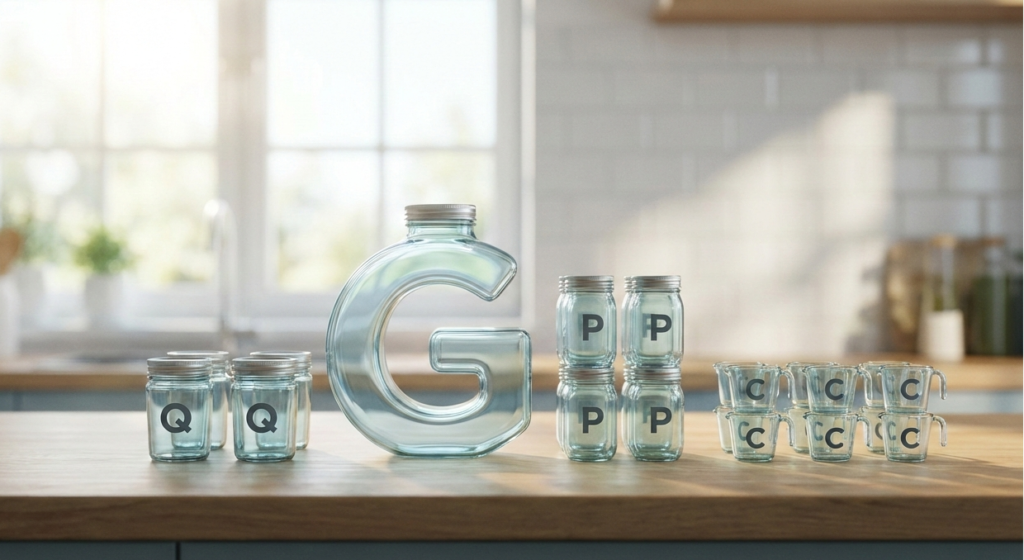
Measurement can feel abstract until it is seen, imagined, and connected to something familiar. Many students struggle to remember how quarts, pints, and cups relate to a gallon because the numbers alone seem disconnected from real-life experience. That is where the concept of Gallon Man becomes incredibly effective. Gallon Man is not just a drawing but a visual storytelling tool that turns a confusing system of customary units into something memorable and logical.
The idea behind Gallon Man is simple. A large outline of a person represents one gallon. Inside that figure are smaller shapes that show how the gallon is divided into quarts, pints, and cups. By looking at the diagram, learners can literally see how each unit fits into the next. This visual hierarchy transforms memorization into understanding, which is why teachers have relied on it for decades.
Understanding how many quarts, pints, and cups are in one gallon is essential for everyday tasks like cooking, home projects, science experiments, and even understanding product packaging. Gallon Man helps bridge the gap between classroom math and practical life by showing relationships instead of just stating them.
What Exactly Is Gallon Man?
Gallon Man is a teaching strategy used to explain liquid measurement relationships in the United States customary system. It is typically drawn as a large “G” shaped figure or a person-shaped outline labeled as one gallon. Within that gallon shape, four large sections represent quarts. Each quart contains two smaller sections for pints, and each pint contains two even smaller sections representing cups.
This nested structure mirrors the actual mathematical relationships between the units. Instead of memorizing separate conversion facts, students see a pattern of doubling as they move from gallons to quarts, quarts to pints, and pints to cups. The visual repetition reinforces comprehension naturally.
Teachers often describe Gallon Man as a memory map. Rather than storing isolated numbers, the brain remembers a picture, and that picture carries all the information needed for conversions.
The Fundamental Relationship Between Gallons, Quarts, Pints, and Cups
At the heart of Gallon Man lies a sequence of proportional divisions. One gallon contains four quarts. Each quart contains two pints. Each pint contains two cups. When these relationships are combined, they create a clear chain that explains all conversions within the system.
This means that a single gallon holds eight pints because each of the four quarts contains two pints. Extending that same logic shows that a gallon contains sixteen cups, since every pint contributes two cups. The structure is not random but built on consistent doubling, which makes it easier to calculate larger or smaller quantities.
The beauty of Gallon Man is that it visually encodes this multiplication pattern. Instead of solving equations each time, learners can mentally “zoom in” on the diagram to determine the answer.
Seeing the Breakdown Step by Step
From One Gallon to Four Quarts
When looking at Gallon Man, the largest sections inside the gallon represent quarts. The gallon is divided into four equal parts, making it easy to understand that four quarts together form one gallon. This is often the first relationship students grasp because it is the most visible division in the diagram.
In practical terms, this conversion is commonly used when dealing with large liquid quantities such as milk containers, paint supplies, or water storage. Recognizing that four quarts equal a gallon allows for quick estimation without needing tools or calculators.
From Quarts to Pints
Each quart in Gallon Man is further divided into two pints. Since there are four quarts in a gallon, doubling those quarts results in eight pints per gallon. The consistent pattern helps learners predict the next step even before they memorize it.
This relationship becomes useful in recipes, especially when preparing soups, sauces, or beverages where quantities are often expressed in pints. Understanding how pints build from quarts encourages flexible thinking when scaling recipes up or down.
From Pints to Cups
Each pint contains two cups, which leads to sixteen cups in a gallon. The steady doubling pattern appears again, reinforcing the mathematical structure visually introduced by Gallon Man. This repetition strengthens retention because the brain recognizes the same relationship occurring at each level.
Cups are the most commonly used unit in household cooking, so this conversion often has the most immediate real-world relevance. Whether measuring flour, liquids, or ingredients for baking, knowing how cups relate back to a gallon provides a deeper sense of proportion.
Why Gallon Man Works So Well for Memory Retention
Educational research consistently shows that visual learning improves comprehension, especially when dealing with hierarchical information. Gallon Man succeeds because it combines imagery, spatial organization, and logical progression into one unified model.
The brain processes images faster than text, and when those images represent meaningful relationships, recall becomes almost automatic. Instead of memorizing that there are sixteen cups in a gallon, learners remember the picture of smaller units nested inside larger ones.
This method also reduces math anxiety. Students who might feel intimidated by numerical conversions often find confidence when they can rely on a visual guide rather than abstract formulas.
Real-Life Applications of Gallon Man Conversions
Understanding these measurements extends far beyond the classroom. In cooking, doubling or halving recipes requires quick mental conversions between cups, pints, and quarts. Gallon Man provides the framework to adjust quantities accurately without guesswork.
In home improvement projects, paint coverage is often calculated in gallons and quarts. Knowing the relationships between units helps estimate how much material is needed, preventing waste or shortages.
Scientific learning also benefits from this understanding. Even though many scientific fields rely on the metric system, foundational measurement skills strengthen overall numerical reasoning and prepare students for more complex conversions.
How Gallon Man Supports Conceptual Math Skills
Gallon Man is more than a mnemonic device. It introduces students to proportional reasoning, a critical mathematical skill. By recognizing how each unit doubles or combines into another, learners begin to understand scaling, ratios, and relationships between quantities.
This early exposure to structured thinking supports later learning in algebra, geometry, and data analysis. Students learn that numbers are not isolated facts but parts of interconnected systems.
The visual nature of Gallon Man also encourages exploratory learning. Students can draw their own versions, color-code sections, or label units, turning passive memorization into active engagement.
Common Misunderstandings That Gallon Man Helps Prevent
Many learners confuse measurement conversions because they try to memorize them as unrelated facts. Without context, it becomes easy to mix up how many pints are in a quart or how cups relate to gallons.
Gallon Man eliminates this confusion by showing that every step follows the same pattern. When students see the structure repeatedly, they internalize the logic instead of relying on rote memorization.
This clarity is especially helpful during exams or practical tasks when quick recall is needed. A mental image can often be retrieved faster than a memorized equation.
Modern Teaching Trends and the Continued Relevance of Gallon Man
Even in an era of digital tools and interactive learning apps, Gallon Man remains widely used because of its simplicity and adaptability. Teachers now incorporate it into smartboard lessons, printable worksheets, and hands-on classroom activities.
The method aligns with contemporary educational approaches that emphasize visual literacy and conceptual understanding. Rather than replacing traditional tools, technology has expanded the ways Gallon Man can be presented and explored.
Its continued presence in education highlights the timeless value of clear visual models in teaching foundational concepts.
Connecting Measurement Knowledge to Everyday Confidence
When learners truly understand how many quarts, pints, and cups are in a gallon, they gain more than just a math skill. They develop confidence in navigating real-world situations that involve quantities, comparisons, and planning.
Measurement becomes intuitive rather than intimidating. Whether preparing meals, organizing events, or tackling DIY projects, the relationships introduced by Gallon Man provide a reliable mental reference.
This sense of mastery transforms measurement from a classroom requirement into a practical life tool.
Conclusion
Gallon Man may look like a simple drawing, but its educational value runs deep. By visually demonstrating that one gallon contains four quarts, eight pints, and sixteen cups, it turns an abstract measurement system into something tangible and easy to remember.
The strength of Gallon Man lies in its clarity. It shows how units connect, why they matter, and how they can be applied in everyday life. This combination of visualization and logic makes it one of the most effective teaching aids for understanding customary liquid measurements.