
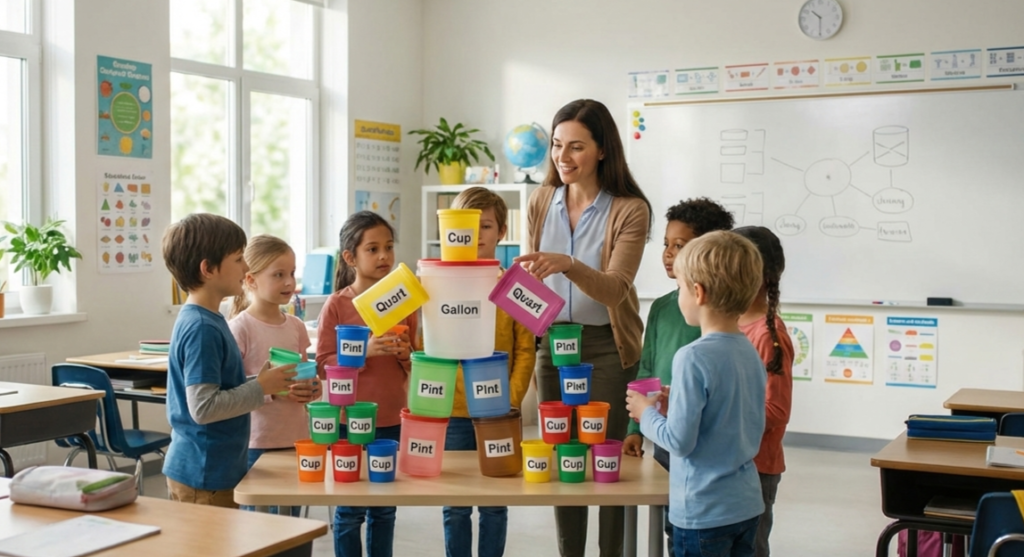
Measurement is one of the first mathematical concepts that connects classroom learning to everyday life. Children encounter it when they pour juice, help with cooking, or see fuel measured at a station, yet understanding how different units relate to each other can feel abstract and confusing. Traditional explanations that rely only on numbers often fail to help students visualize how quarts, pints, and cups actually fit together. This gap between memorization and understanding is where many learners struggle.
Teachers constantly look for ways to transform abstract math into something students can see, touch, and remember. Visual learning tools have become essential in modern classrooms because they help students build mental connections instead of relying on rote memorization. Gallon Man is one of the most widely used strategies for teaching liquid measurement because it transforms numbers into a memorable visual story that students can easily grasp.
What Is Gallon Man and How Does It Work?
Gallon Man is a visual representation designed to show how units of liquid measurement relate to one another within the customary system. The figure is usually drawn as a large outline of a person, with the main body representing a gallon. Inside the body are shapes that symbolize quarts, and within those are smaller sections representing pints and cups. This nested structure allows students to see how smaller units combine to form larger ones.
Instead of memorizing that four quarts equal a gallon or that two cups equal a pint, students see those relationships physically arranged. The visual acts like a map, guiding learners through the hierarchy of measurement. Because the image resembles a person, it becomes more engaging and easier for children to remember.
Teachers often involve students in constructing their own Gallon Man using paper cutouts, which strengthens comprehension through hands-on learning. The act of building the figure reinforces the relationships between units in a way that worksheets alone cannot achieve.
Why Visual Learning Is So Effective in Mathematics Education
The Brain Processes Images Faster Than Text
Educational research consistently shows that the brain interprets visual information more quickly than written information. When students encounter a diagram, they can process relationships instantly rather than decoding them step by step. Gallon Man leverages this natural cognitive strength by turning numerical conversions into a spatial arrangement.
Children especially benefit from visuals because their abstract reasoning skills are still developing. A diagram provides a bridge between concrete experiences and symbolic math, allowing learners to attach meaning to numbers.
Visual Tools Reduce Cognitive Overload
When students are asked to memorize multiple conversions at once, they often feel overwhelmed. Gallon Man simplifies the learning process by organizing all relationships into one unified image. Instead of remembering several separate facts, students recall a single visual framework that contains all the information they need.
This approach reduces frustration and builds confidence, which is critical during early math instruction. Students are more likely to engage when they feel capable of understanding the material.
How Gallon Man Encourages Conceptual Understanding Instead of Memorization
Seeing the “Big Picture” of Measurement
One of the main goals of mathematics education is helping students understand relationships rather than isolated facts. Gallon Man allows learners to see how measurement units fit together as parts of a whole. The structure visually demonstrates that a gallon is not just a number but a container made up of smaller equal sections.
This understanding helps students solve problems logically. Instead of asking themselves which formula to use, they mentally picture the diagram and reason through the relationships. The learning becomes intuitive rather than mechanical.
Supporting Long-Term Retention
Information tied to imagery is easier to recall because it activates multiple areas of the brain. Students often remember Gallon Man years after encountering it because the character-like design creates a memorable association. This retention supports future learning when students encounter more advanced topics such as ratios, conversions, or scientific measurement.
Teachers value tools that create lasting understanding, and Gallon Man has proven effective precisely because students do not forget it easily.
The Role of Hands-On Learning in Student Engagement
Active Participation Makes Learning Meaningful
Modern teaching strategies emphasize active learning, where students participate directly in the educational process. Creating a Gallon Man craft invites students to cut, label, assemble, and discuss measurement units. This transforms a passive lesson into an interactive experience.
As students manipulate the pieces, they physically demonstrate how units combine, reinforcing comprehension through movement and collaboration. Engagement increases because learners are not simply listening but doing.
Encouraging Collaboration and Discussion
Classroom activities involving Gallon Man often lead to peer discussions. Students explain relationships to one another, ask questions, and work together to assemble the model. These conversations deepen understanding and allow teachers to assess comprehension informally.
The visual also becomes a shared reference point that teachers and students can revisit throughout the unit.
How Gallon Man Aligns With Modern Educational Standards
Educational frameworks increasingly emphasize conceptual mastery, critical thinking, and real-world application rather than memorization alone. Gallon Man aligns with these goals by helping students understand measurement as a system of relationships.
Teachers are encouraged to use multiple representations of knowledge, including visual, verbal, and kinesthetic methods. Gallon Man naturally integrates all three by combining imagery, explanation, and hands-on construction.
This alignment makes it a valuable instructional strategy in classrooms focused on deeper learning outcomes.
Bridging the Gap Between Mathematics and Everyday Life
Making Measurement Relatable
Students often ask why they need to learn conversions, especially when they seem disconnected from daily experiences. Gallon Man helps teachers connect lessons to familiar situations such as cooking, sharing drinks, or filling containers.
By visualizing how smaller quantities build into larger ones, students can better understand real-world measurements. The learning feels practical rather than theoretical.
Preparing Students for Future STEM Learning
Understanding measurement relationships lays the foundation for science, engineering, and technical subjects. Gallon Man introduces students to hierarchical systems and proportional thinking, skills they will use in laboratory settings and advanced math courses.
Early exposure to these concepts builds confidence as students progress into more complex academic areas.
Adapting Gallon Man for Different Learning Styles
Every classroom includes learners with different strengths and preferences. Some students learn best visually, while others benefit from auditory explanation or physical interaction. Gallon Man is flexible enough to support multiple learning styles simultaneously.
Teachers may present it as a colorful poster, an interactive notebook activity, or even a digital graphic. This adaptability ensures that all students can access the concept in a way that resonates with them.
The tool’s simplicity allows educators to modify it for diverse classrooms, including those with varying language proficiency or learning needs.
The Psychological Impact of Friendly Visual Characters in Education
The human-like design of Gallon Man is not accidental. Educational psychology shows that students respond positively to characters and storytelling elements because they create emotional engagement. When learning feels friendly and approachable, anxiety decreases and curiosity increases.
Younger learners especially benefit from associating academic material with playful imagery. Gallon Man becomes more than a diagram; it becomes a memorable figure that guides them through a challenging concept.
This emotional connection enhances motivation, which is a key factor in successful learning.
Common Classroom Strategies That Incorporate Gallon Man
Teachers often introduce Gallon Man during units on customary measurement as a foundational reference. Once students understand the diagram, it is used repeatedly in problem-solving discussions, journal reflections, and real-life examples.
Rather than replacing traditional instruction, Gallon Man complements it by giving students a visual anchor. Lessons that include discussion, drawing, and application activities reinforce the model in multiple contexts.
The strategy’s effectiveness lies in its consistency. Students return to the same visual framework whenever they need to reason through a conversion.
Recent Trends in Visual and Experiential Learning
Education has increasingly shifted toward multisensory instruction supported by research in cognitive science. Visual anchors like Gallon Man reflect this movement toward teaching methods that combine imagery, interaction, and context.
Digital classrooms now adapt the concept through interactive whiteboards and virtual manipulatives, allowing students to explore measurement relationships dynamically. Even in technology-rich environments, the core idea remains unchanged because the visual structure continues to support understanding.
This evolution shows how timeless teaching tools can adapt to modern educational settings without losing their effectiveness.
Why Gallon Man Remains Popular Decades After Its Introduction
Many educational trends come and go, yet Gallon Man has remained widely used because it solves a persistent challenge. Measurement relationships are inherently abstract, and students still need clear, visual explanations.
Teachers continue to rely on it because it is simple to implement, memorable for students, and aligned with how children naturally learn. Its staying power reflects its practicality rather than novelty.
The tool demonstrates that effective education does not always require complex technology. Sometimes the most powerful strategies are those that communicate ideas clearly and visually.
Conclusion
Gallon Man endures as a classroom favorite because it transforms a difficult concept into something students can see, build, and remember. By turning measurement relationships into a visual structure, teachers help learners move beyond memorization toward genuine understanding.
The strategy supports diverse learning styles, encourages engagement, and connects mathematics to everyday experiences. Its effectiveness lies in its clarity, its adaptability, and its ability to make abstract ideas feel tangible.