
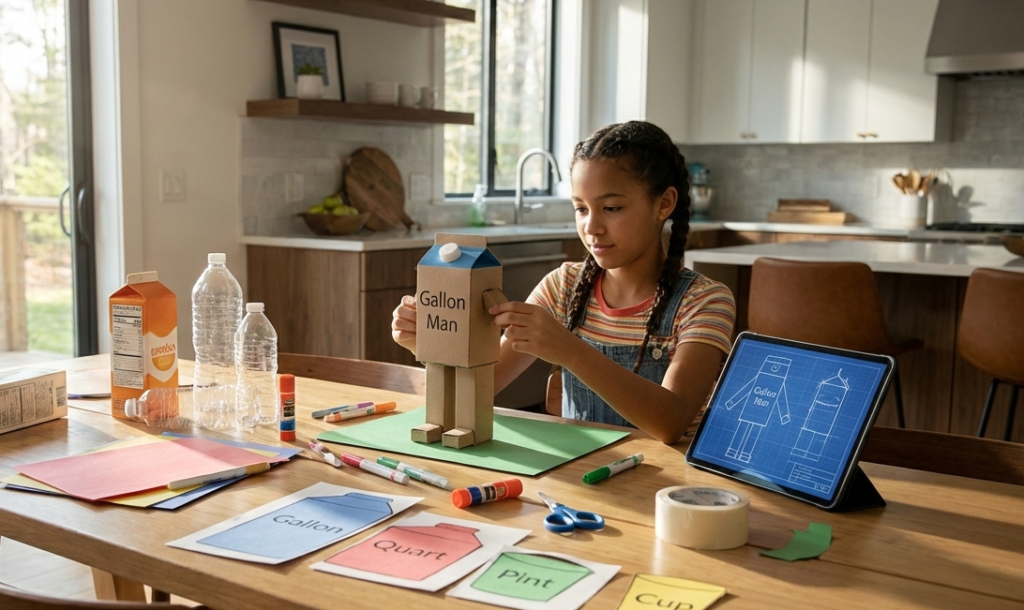
Learning measurement conversions can feel abstract when students only see numbers written on a board. Terms like gallons, quarts, pints, and cups often seem disconnected from real life, making it harder for learners to visualize how these units relate to one another. A DIY Gallon Man model changes that experience by turning measurement into something students can see, touch, and build themselves.
Creating this hands-on visual at home transforms a memorization task into an engaging activity. Instead of trying to remember formulas, students understand the structure of capacity measurement through a simple model shaped like a person. This approach supports deeper comprehension, encourages creativity, and allows families to participate in learning together.
In today’s learning environment, where interactive and home-based education is becoming more common, building a Gallon Man model is an effective way to reinforce math skills without relying on worksheets alone. The project blends art, logic, and spatial understanding, making it ideal for both younger learners and older students who need a refresher on customary units.
Understanding the Idea Behind Gallon Man
Before building the model, it helps to understand what Gallon Man represents conceptually. The character is a visual metaphor for the relationship between units of liquid capacity in the customary measurement system. The large body represents one gallon, while smaller shapes inside it symbolize quarts, pints, and cups.
This structure allows students to see how measurements “fit” within each other rather than treating them as unrelated numbers. When learners physically assemble the pieces, they recognize that four quarts combine to form a gallon, each quart contains two pints, and each pint contains two cups. The relationships become intuitive because they are literally constructed layer by layer.
Educational research increasingly emphasizes tactile and visual learning because it activates multiple areas of the brain at once. Building Gallon Man aligns with this approach by combining movement, design, and reasoning into a single activity that strengthens retention.
Why Making Gallon Man at Home Enhances Learning
Classroom demonstrations are helpful, but when students create their own model, the learning experience becomes personal. Constructing Gallon Man requires students to measure, cut, label, and organize components, which naturally reinforces the same concepts the model is meant to teach.
At home, students can move at their own pace, revisit the model whenever they need practice, and even redesign it to match their learning style. This flexibility encourages exploration rather than passive observation. Parents also gain insight into what their children are studying, allowing them to support practice in a meaningful way.
The act of crafting something with your hands also strengthens memory formation. When students recall the model later, they often remember the building process itself, which helps them reconstruct the measurement relationships mentally.
Materials Students Can Use to Build Their Model
Simple Household Supplies Work Perfectly
One of the best aspects of this project is that it does not require specialized tools. Students can create an effective Gallon Man using materials commonly found at home, such as construction paper, cardboard, markers, glue, and scissors. Recycled materials like cereal boxes can also be used to make the model sturdier.
Using different colors for each unit helps distinguish the measurement levels visually. For example, one color can represent quarts, another pints, and another cups. This color association strengthens recognition and helps students quickly recall how the units relate.
Encouraging students to choose their own colors or decorating style adds a sense of ownership. When learners feel they have designed something unique, they are more likely to engage with it repeatedly.
Shaping the Gallon Man Figure
Turning Measurement Into a Character
The defining feature of Gallon Man is its human-like shape, which makes the model memorable and approachable. Students begin by creating a large outline to represent the gallon. This becomes the “body” that holds all other units.
Inside this shape, four sections are added to symbolize the quarts. These are often drawn as large shapes positioned like arms and legs or arranged symmetrically within the body. The design does not need to be perfect; what matters is that students clearly see the division into four equal parts.
As they attach each section, students naturally begin associating the number four with quarts in a gallon. This repeated visual cue reinforces the foundational conversion without rote memorization.
Adding Pints and Cups to Complete the Structure
Building the Layers of Measurement
Each quart section is then divided into two smaller parts to represent pints. Students physically placing two shapes within each quart helps them see that the quantity doubles as the unit becomes smaller. This visual scaling demonstrates proportional relationships far more effectively than numbers on a worksheet.
The process continues by adding cups inside each pint. When students complete this final layer, they see the full structure of sixteen cups within one gallon. At this stage, the model clearly shows how all units connect, forming a visual map of measurement relationships.
Labeling each section is essential because it links vocabulary to structure. Writing the unit names directly on the model strengthens terminology recognition and supports long-term retention.
How This Activity Supports Different Learning Styles
Every student processes information differently, and Gallon Man succeeds because it integrates multiple learning methods at once. Visual learners benefit from seeing the hierarchy of units displayed spatially. Kinesthetic learners engage through cutting, arranging, and assembling components. Verbal learners reinforce understanding by discussing the relationships as they build.
This blended approach mirrors modern educational strategies that emphasize active participation rather than passive listening. By involving several senses simultaneously, the project helps students internalize concepts that might otherwise feel abstract.
Students who struggle with traditional math instruction often find renewed confidence through creative activities like this. The model gives them a reference they can return to whenever they need reassurance.
Making the Model Durable for Long-Term Practice
A DIY Gallon Man is most effective when students can use it repeatedly. Mounting the pieces on thicker cardboard or laminating them with clear covering helps preserve the model. Some families even create movable parts using fasteners or Velcro so students can take sections apart and rebuild them as practice.
This interactive feature transforms the model into a reusable study tool rather than a one-time craft. Students can quiz themselves by reassembling the units, reinforcing memory through repetition.
Having a physical reference available during homework or test preparation reduces anxiety because learners can visualize conversions rather than guessing.
Connecting Gallon Man to Real-Life Applications
Measurement becomes more meaningful when students connect it to everyday experiences. After building the model, families can relate it to cooking, pouring beverages, or filling containers. Seeing how cups combine into larger quantities reinforces the same structure represented by the model.
These real-world connections help students understand why measurement matters beyond the classroom. When learners recognize practical uses, they are more motivated to remember and apply what they have learned.
Using Gallon Man alongside real measuring tools deepens this understanding, bridging the gap between symbolic learning and tangible experience.
Adapting the Project for Different Age Groups
Younger students may focus primarily on assembling and labeling the parts, gaining familiarity with the names and relationships of units. Older learners can expand the activity by exploring conversions mathematically, calculating totals, or explaining the relationships in their own words.
Some students enjoy redesigning Gallon Man into themed characters, adding personality while maintaining the structure. This creative adaptation keeps the activity fresh and encourages repeated engagement.
The flexibility of the model allows it to grow with the learner, making it valuable across several grade levels rather than a single lesson.
Why DIY Learning Tools Are Trending in Modern Education
Home-based educational crafts have gained popularity as families seek meaningful, screen-free learning experiences. Projects like Gallon Man encourage collaboration, creativity, and conceptual understanding without requiring expensive materials.
Educators increasingly recommend hands-on reinforcement at home because it extends classroom learning into daily life. DIY models allow students to revisit concepts informally, which strengthens mastery over time.
This trend reflects a broader shift toward experiential education, where students learn by doing rather than memorizing isolated facts.
Encouraging Students to Reflect on What They Built
After completing the model, students benefit from explaining how it works to someone else. Teaching a concept, even informally to a parent or sibling, strengthens understanding because it requires organizing thoughts and articulating relationships clearly.
Reflection turns the activity into more than a craft project. It becomes a demonstration of comprehension, allowing students to connect the visual structure to the mathematical logic behind it.
As they describe how smaller units combine to form larger ones, students reinforce the conceptual framework that Gallon Man was designed to illustrate.
Conclusion
Building a DIY Gallon Man model at home is a simple yet powerful way to make measurement concepts clear, memorable, and engaging. By transforming abstract numbers into a visual structure, students gain a deeper understanding of how gallons, quarts, pints, and cups relate to one another.
The activity blends creativity with mathematical reasoning, making it accessible to a wide range of learners. It encourages participation, strengthens retention, and connects classroom knowledge to real-life experiences. Most importantly, it empowers students to take an active role in their education by constructing a tool they can use again and again.