
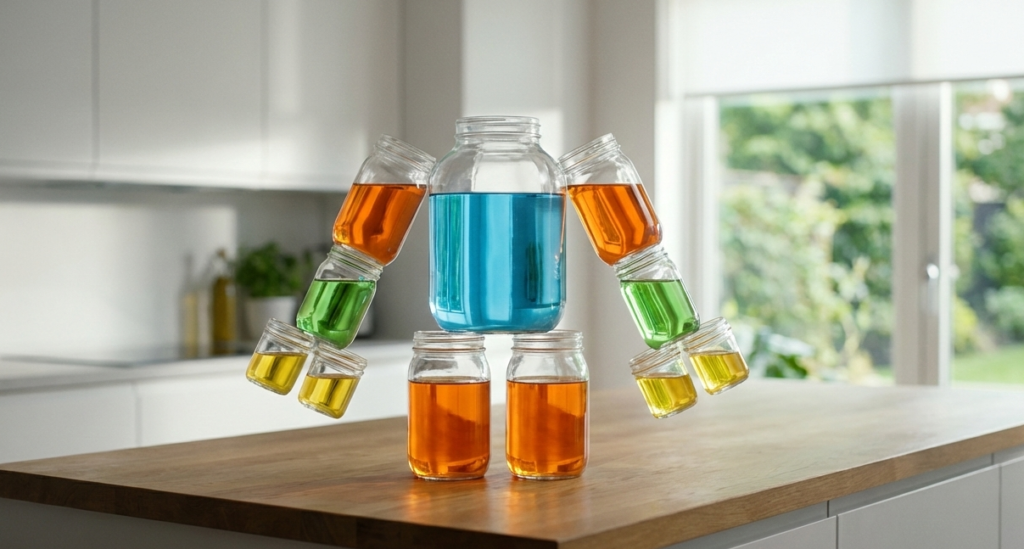
Understanding liquid measurements can feel surprisingly difficult, especially for students who are just beginning to work with units like gallons, quarts, pints, and cups. These terms appear simple on the surface, yet many learners struggle to remember how they connect or convert from one to another. The challenge is not a lack of ability, but rather the abstract nature of measurement itself. When numbers exist without a visual relationship, they are harder to retain.
This is where Gallon Man becomes one of the most effective learning tools ever used in classrooms. Instead of memorizing disconnected facts, students see a structured visual model that turns conversions into a pattern. The easiest way to remember liquid conversions is not through repetition alone, but through visualization, association, and storytelling, all of which Gallon Man naturally provides.
Understanding the Problem with Traditional Memorization
Many learners are taught conversions through formulas or repeated drills. They may hear statements such as “there are four quarts in a gallon” or “two cups make a pint,” yet those facts often disappear under pressure during tests or real-world use. Rote memorization demands constant review because it lacks meaning.
When students cannot picture how units relate, they tend to mix them up. A quart might be confused with a pint, or they may forget how many cups belong inside larger measurements. The brain remembers relationships far better than isolated numbers, which is why visual learning strategies consistently outperform memorization-only approaches.
Gallon Man solves this problem by turning measurement into something that can be seen, built, and understood spatially.
What Is Gallon Man and Why It Works So Well?
Gallon Man is a visual diagram shaped like a person that represents the hierarchy of liquid measurements. The large body represents one gallon, while smaller shapes inside illustrate quarts, pints, and cups. Each unit is placed in a way that clearly shows how many of the smaller units fit into the larger one.
Because the design resembles a friendly character, students engage with it emotionally as well as intellectually. The structure becomes memorable not just because it contains information, but because it tells a story of how measurements “fit together.”
A Visual Representation of Measurement Relationships
The large central shape symbolizes the gallon. Inside that space are four quart shapes, each quart holding two pints, and each pint containing two cups. Instead of memorizing several separate facts, learners recognize a repeating pattern of division. The structure visually communicates that each step breaks into smaller, equal parts.
This nested design mirrors how the brain naturally organizes information. When learners see repetition and symmetry, they are far more likely to remember the sequence without conscious effort.
The Easiest Way to Remember Conversions Is to Think in Layers
The secret to mastering Gallon Man is not simply looking at the picture, but understanding the layered structure it represents. Each measurement is a level within the whole, like rooms inside a house. A gallon is the entire building, quarts are the main sections, pints are subdivisions, and cups are the smallest usable spaces.
When students imagine moving downward through these layers, conversions become logical rather than mechanical. Instead of asking themselves what to multiply or divide, they simply visualize breaking a container into smaller containers.
This mental model transforms conversions into a process of unfolding rather than calculating.
Seeing the Hierarchy at a Glance
By associating each unit with its position, learners remember that larger measurements always contain smaller ones in consistent ratios. The predictability removes guesswork and builds confidence.
Why Visual Learning Improves Retention in Measurement Concepts
Educational research has long shown that visual tools enhance comprehension, especially in subjects involving structure and scale. Measurement is not just numerical; it is spatial. Gallon Man bridges the gap between numbers and physical reality.
When learners draw or assemble the diagram themselves, they activate multiple forms of memory at once. Visual memory helps them recall the layout, kinesthetic memory reinforces the act of constructing it, and conceptual understanding grows as they observe the repeated divisions.
This combination is far more powerful than reading definitions or solving isolated problems.
Turning Conversions into a Story Instead of a Formula
One of the easiest strategies for remembering Gallon Man is to treat it like a story about sharing. Imagine a gallon as a full container that must be evenly distributed. It can be shared among four quarts, each quart can be shared again into two pints, and those pints can be shared into cups.
Because the process feels like dividing something tangible, the relationships make intuitive sense. Students no longer feel like they are memorizing arbitrary facts. They are simply following a pattern of fair sharing that repeats at each level.
Story-based learning anchors knowledge in meaning, which is why students often recall Gallon Man years after first encountering it.
How Gallon Man Supports Both Beginners and Advanced Learners
For beginners, Gallon Man provides clarity and confidence. It removes the intimidation of multiple units by presenting them as parts of a single whole. Students who once felt confused begin to see measurement as organized and predictable.
For more experienced learners, the model becomes a mental shortcut. Even when solving complex problems involving scaling or conversions, they can quickly visualize the structure and determine relationships without writing everything out.
This adaptability is one reason Gallon Man remains relevant across grade levels.
The Role of Hands-On Creation in Strengthening Memory
Many teachers encourage students to build their own version of Gallon Man using paper cutouts or drawings. The act of assembling the diagram forces learners to think about placement and quantity. They are not passively observing information; they are constructing understanding.
Creating the model also personalizes the learning experience. When students decorate or label their diagrams, they develop ownership over the concept. That personal connection makes recall easier because the information feels familiar rather than imposed.
Learning becomes an activity instead of an obligation.
Why Gallon Man Is Still Popular in Modern Classrooms
Despite advances in digital tools and interactive learning platforms, Gallon Man continues to be widely used because it is simple, adaptable, and effective. Its design translates easily to printed worksheets, classroom posters, and digital whiteboards.
Modern educators often blend the traditional diagram with technology by using animations or interactive versions that allow students to explore how units expand and contract. Even in these updated formats, the core visual structure remains unchanged because it already aligns so well with how people learn.
The longevity of Gallon Man demonstrates that strong teaching tools do not need to be complex to be powerful.
Making Real-World Connections to Reinforce Understanding
Liquid measurement is not just an academic exercise. It appears in cooking, science experiments, home improvement, and everyday problem-solving. When students connect Gallon Man to real-life situations, the model becomes even more meaningful.
Visualizing how many cups are in a larger container helps when adjusting recipes. Understanding how quarts relate to gallons makes sense when dealing with storage or mixing solutions. These applications reinforce the diagram’s usefulness beyond the classroom.
When knowledge proves practical, it is remembered longer.
Avoiding Common Mistakes When Learning Conversions
Students sometimes attempt to memorize the numbers without referring back to the structure. This approach can lead to confusion because it disconnects facts from their visual framework. The easiest way to remember conversions is to always picture the Gallon Man layout first and let the relationships guide the calculation.
Relying on visualization ensures accuracy because each conversion follows the same pattern of subdivision. The learner is not guessing or recalling isolated data, but reconstructing the relationship logically.
This shift from memorization to reasoning is what makes Gallon Man so effective.
How Parents and Educators Can Reinforce the Concept at Home
Families can support learning by encouraging children to redraw Gallon Man from memory or explain how the units fit together. Explaining the structure aloud strengthens understanding because teaching requires clarity of thought.
Even simple conversations about measurements in daily tasks can prompt students to recall the diagram. Each time they visualize the structure again, the connections grow stronger and more automatic.
Repetition through meaningful use builds lasting mastery.
Why Gallon Man Is More Than Just a Diagram
At its core, Gallon Man represents a philosophy of learning that values understanding over memorization. It shows that when information is organized visually and logically, it becomes easier to retain and apply.
The model demonstrates that education works best when concepts are connected, tangible, and engaging. Rather than overwhelming learners with abstract conversions, Gallon Man offers a map they can follow confidently.
This is why so many students remember it long after leaving the classroom.
Conclusion
The easiest way to remember liquid conversions using Gallon Man is to rely on its visual hierarchy and think of measurements as parts of a whole rather than isolated numbers. By picturing how each unit fits within the next, learners replace memorization with understanding, making conversions faster, clearer, and far less stressful.
Gallon Man succeeds because it transforms an abstract topic into something visible, relatable, and logical. Whether used by beginners encountering measurements for the first time or by older students needing a quick mental reference, it remains one of the most effective educational tools for mastering liquid conversions.